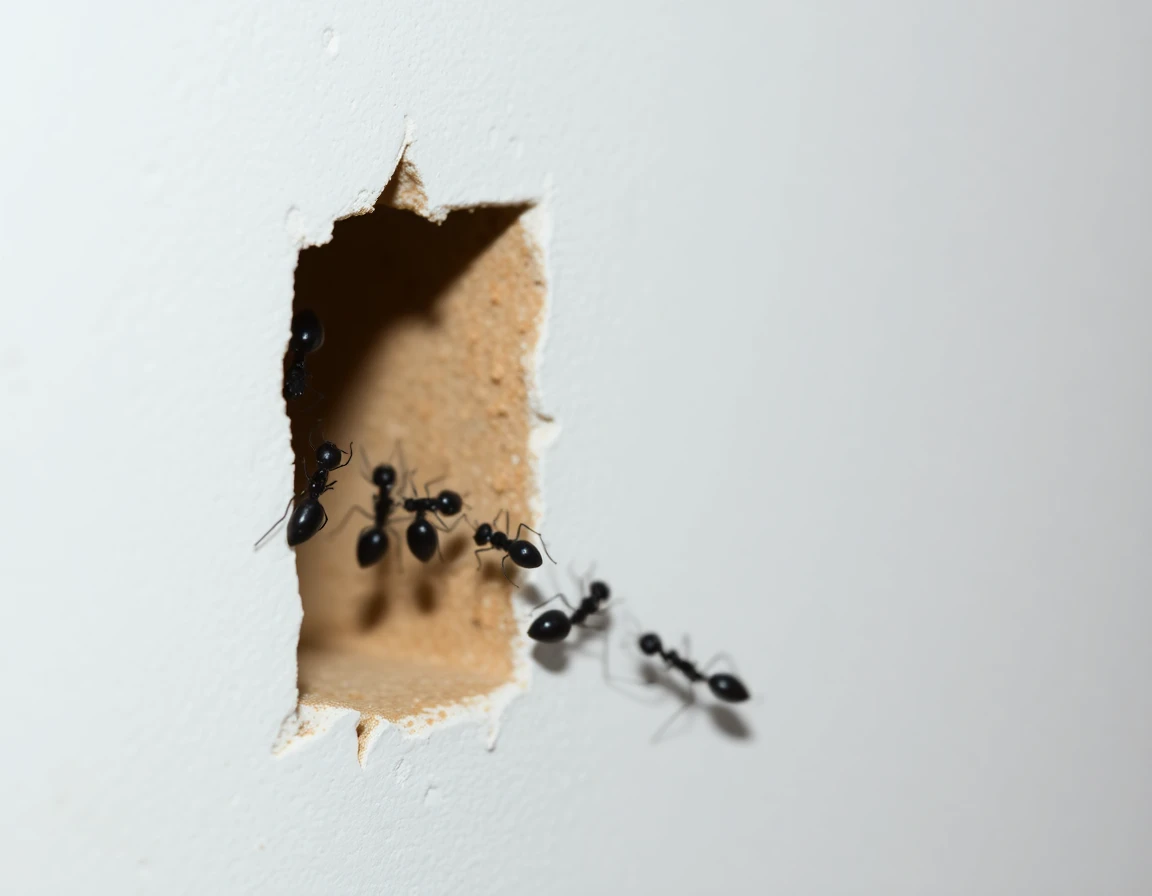
Ant Treatment in French-speaking Switzerland
Professional ant control targeting the colony, not just the visible trail. Our slow-acting baits reach the queen and eliminate the infestation at its source.
Get a Free QuoteWhy Ant Problems Are Harder to Solve Than They Look
An ant trail marching across your kitchen worktop is just the visible tip of a large, complex organisation. The ants you see are worker ants — typically 10–20% of the colony's total population — gathering food to bring back to the nest. The nest itself may be outdoors, beneath paving, in a lawn, inside cavity walls or under floorboards. It contains thousands or tens of thousands of individuals, including the queen (or queens) who are responsible for all reproduction.
Using a surface spray on the trail you can see will kill the workers present and disrupt the trail temporarily. But the colony will simply send new workers, often via a different route. The nest remains completely unaffected. This is why over-the-counter sprays rarely provide lasting results against an established ant infestation.
Effective treatment must reach the colony and specifically the reproductive individuals. This is achieved through slow-acting bait that workers collect and carry back to the nest, where it is shared with the queen and developing larvae via trophallaxis (food exchange), progressively eliminating the entire population.
Common Ant Species in French-speaking Switzerland
Black garden ant (Lasius niger)
The most common species. Workers are 2–4 mm long, matt black. Usually nests outdoors but enters buildings in search of sweet foods. Colonies can reach 15,000 individuals.
Pharaoh ant (Monomorium pharaonis)
A serious pest in heated buildings — hospitals, hotels, apartment blocks. Tiny (1.5–2 mm), pale yellow-brown. Colonies can fragment when disturbed, making chemical sprays counterproductive.
Pavement ant (Tetramorium caespitum)
Dark brown, 2.5–3 mm. Nests in cracks in paving, under stones and in foundations. Typically enters buildings at ground level.
Carpenter ant (Camponotus species)
Large ants (6–12 mm), black or two-tone. Excavate galleries in wood — potentially causing structural damage. Require specialist treatment.
Identifying the ant species present is important because different species require different treatment approaches. Never use a surface spray on pharaoh ants — this causes the colony to split (budding), spreading the infestation to new areas.
Our Ant Treatment Approach
Species identification
We correctly identify the ant species to select the most effective bait formulation and active ingredient. This step is essential — the wrong treatment can make matters significantly worse, especially with pharaoh ants.
Bait station placement
We place bait stations along active ant trails and near entry points. The bait is formulated to be attractive to the target species and contains a slow-acting active ingredient that gives workers time to carry it back to the colony and share it before dying.
Do not use sprays alongside bait
It is important not to use any repellent sprays or surface cleaners near the bait stations after treatment. These repel ants from the bait and prevent uptake. We will advise you on what to avoid during the treatment period.
Prevention advice
We advise on the environmental conditions that are attracting ants — typically food sources, moisture and entry points — and recommend practical steps to reduce the risk of reinfestation once the colony is eliminated.
Get a Free Quote
Tell us about your ant problem and we will find the right solution.
Need a pest control expert?
Contact us for a free, no-obligation quote. We respond quickly throughout French-speaking Switzerland.
Get a Free Quote