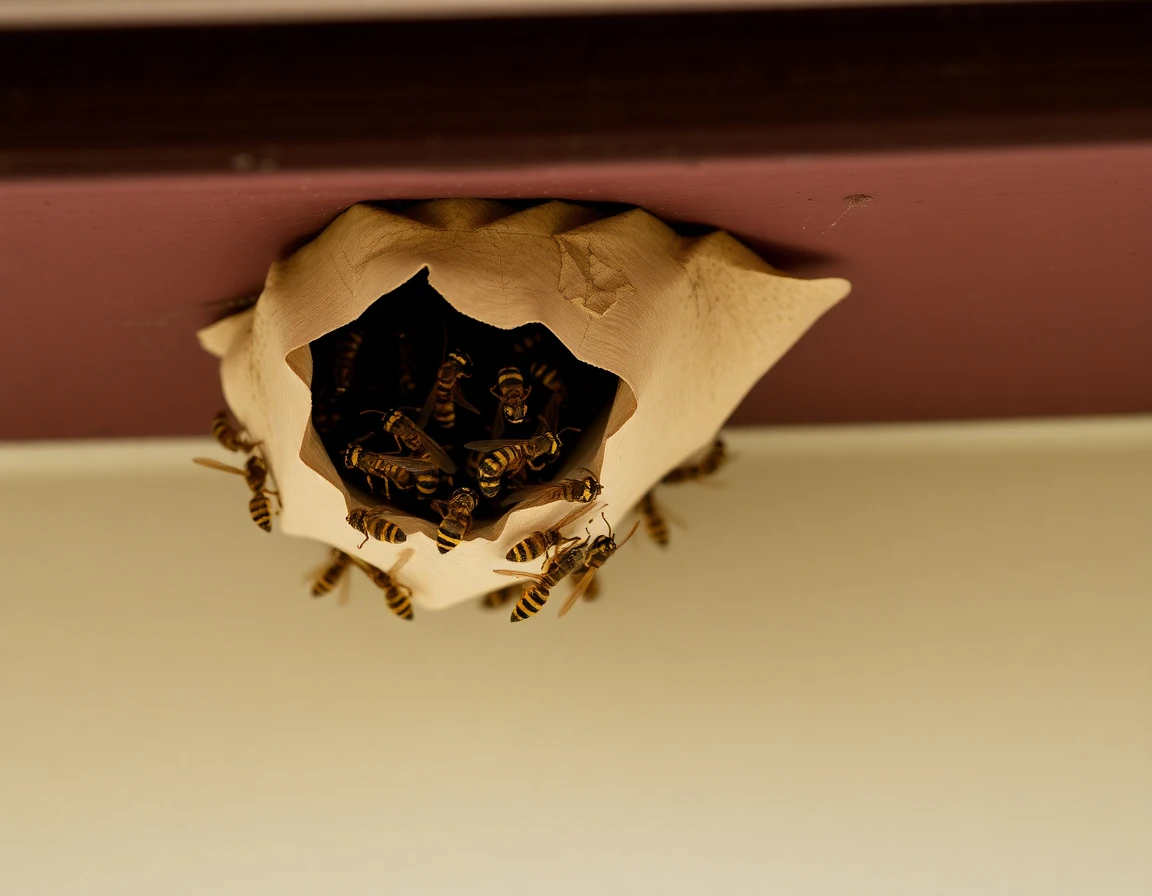
Wasp & Hornet Nest Removal in French-speaking Switzerland
Never attempt to remove a wasp or hornet nest yourself. Our certified professionals use full protective equipment and appropriate insecticides for rapid, safe nest elimination.
Never attempt to remove a wasp or hornet nest yourself. Each nest can contain thousands of insects that will attack when threatened. Wasp and hornet stings can cause severe anaphylactic reactions, particularly in people who are allergic. Always call a professional.
Wasps & Hornets: Identification and Risks
The two most common stinging insects requiring professional nest removal in French-speaking Switzerland are the common wasp (Vespula vulgaris) and the European hornet (Vespa crabro). Both species build papery nests from chewed wood fibres, and both become increasingly aggressive in late summer as colony populations peak and food sources become scarce.
Common Wasp (Vespula vulgaris)
- 12–17 mm long, yellow and black striped
- Nests underground, in roof spaces, wall cavities, garden sheds and trees
- Colonies of 3,000–8,000 workers at peak (July–September)
- Can sting multiple times
European Hornet (Vespa crabro)
- 25–35 mm long — considerably larger than a wasp
- Brown, yellow and orange colouring
- Nests in hollow trees, roof timbers, wall cavities and old structures
- Active day and night — attracted to light
If the insect you have seen is entirely black and yellow, is smaller than a wasp, and the nest is hanging from a tree branch, see our Asian hornet page — this is a different and invasive species requiring specialist handling.
When Should You Call a Professional?
The nest is inside your home
Nests in wall cavities, loft spaces, under eaves or inside outbuildings present a high risk and require immediate professional attention.
Someone in the household is allergic to stings
Allergic reactions to wasp stings can be life-threatening. Do not take any risks — call us immediately.
The nest is near a playground or high-traffic area
Any nest within reach of children, pets or pedestrians should be treated as a priority.
The nest is in a garden but away from activity areas
A nest far from regular human activity in late spring may not require immediate intervention. But monitor it carefully — colonies grow very rapidly as summer progresses.
You are not certain what type of nest it is
If you are unsure whether you are dealing with wasps, hornets or something else, contact us for advice before taking any action.
How We Remove Wasp and Hornet Nests
Our technicians arrive in full protective suits and carry out the treatment safely and efficiently. We apply an appropriate insecticide directly into the nest entrance, which is then carried through the nest by contact. The colony is typically inactivated within a few hours. Nest removal (physical removal of the structure) is carried out once the colony is confirmed dead.
For ground nests or nests in inaccessible locations, we may use dust insecticide applied with a bellows into the entrance, which is equally effective. Treatments typically take less than an hour to carry out.
Important: empty wasp nests are not re-used the following year. However, the location may be used again for a new nest. We advise on how to discourage new colony establishment in the same spot.
Request Urgent Assistance
Wasp and hornet nest removals are treated as priority interventions. Contact us now.
Need a pest control expert?
Contact us for a free, no-obligation quote. We respond quickly throughout French-speaking Switzerland.
Get a Free Quote