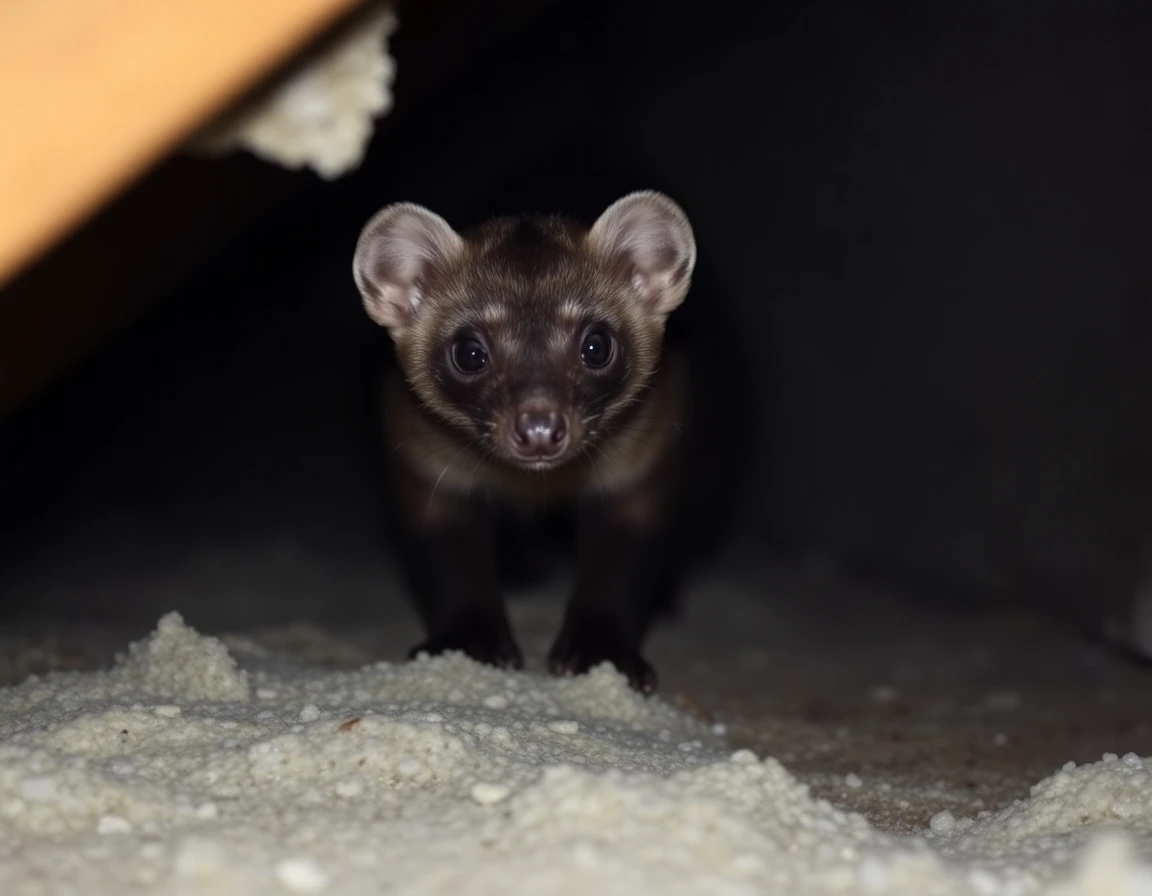
Stone Marten in Your Loft? Professional Exclusion in French-speaking Switzerland
Stone martens (fouines) nesting in roof spaces cause serious damage. Our humane, legally compliant exclusion methods remove them permanently — without harming the animal.
Get a Free QuoteProtected species: The stone marten (Martes foina) is a protected mammal under Swiss wildlife law. Lethal control is not permitted. All interventions must use exclusion and deterrence methods.
What Is a Stone Marten?
The stone marten (also called the beech marten or fouine in French) is a medium-sized mustelid — a relative of the weasel, ferret and otter — native to Europe and Central Asia. It has adapted exceptionally well to urban and suburban environments in French-speaking Switzerland, where it is commonly found nesting in roof spaces, garages, barns and car engine bays.
Stone martens are primarily nocturnal and solitary. They are territorial and will aggressively defend their nesting site, often scent-marking it with musk to deter competitors. Unfortunately, this territorial behaviour means that even after one animal has been excluded, a new marten may attempt to re-enter the same site unless access is permanently blocked and the scent removed.
What Damage Can a Stone Marten Cause?
Roof insulation
Martens tear up and compress roof insulation for bedding and to create access tunnels, dramatically reducing its thermal performance.
Vehicle damage
Stone martens are notorious for gnawing on rubber hoses, wiring and insulation in car engine bays — a costly problem affecting hundreds of Swiss car owners each year.
Structural damage
They enlarge access holes, damage roof timbers, and their droppings corrode and stain materials over time.
Noise
Their nocturnal activity — running, fighting, dragging food — causes significant noise disturbance, particularly in bedrooms beneath the loft.
Odour
Their musk glands produce a strong, persistent odour in the loft space, particularly during breeding season.
Secondary pests
Marten nests and food caches attract insects and other scavengers, potentially creating secondary pest problems.
Our Stone Marten Exclusion Method
Because lethal control is illegal, our approach focuses on two things: making the marten leave voluntarily, and permanently sealing the entry points so it cannot return. Our programme typically involves three phases.
Inspection and Access Mapping
We inspect the exterior and interior of the building to identify all entry and exit points used by the marten, plus any secondary access points it may use if the primary one is blocked. We also assess the extent of damage and whether any young are currently in the nest (young martens must not be separated from their mother).
Deterrence and Exclusion
We install one-way exclusion devices at entry points, allowing the marten to leave but not return. We apply repellent products (approved chemical deterrents and biological scent deterrents) inside the loft space to make it unattractive to the resident animal. Once we are confident the loft is clear, we permanently seal all access points with appropriate materials (metal mesh, expanding foam, cement) that the marten cannot gnaw through.
Decontamination and Follow-up
Removing the scent marks left by the marten is critical — without this step, a new marten will be attracted to the same site. We decontaminate the loft with enzymatic cleaners that break down musk pheromones and carry out a follow-up inspection to confirm the exclusion has been successful.
Request a Free Assessment
Is a stone marten causing problems at your property? Contact us for a free assessment and quote.
Need a pest control expert?
Contact us for a free, no-obligation quote. We respond quickly throughout French-speaking Switzerland.
Get a Free Quote